




When Emmanuel Lahai finished high school, his family—like many others in Sierra Leone—was facing uncertainty. His father was out of work, and youth unemployment was painfully high.
For many young people, the future felt limited and predictable. But for Emmanuel, a simple moment changed everything.
“One random day I came across the book Rich Dad Poor Dad by Robert Kiyosaki,” he recalls. “The book spoke about millionaires and billionaires and how they solved problems, so I started thinking — is there any way I can help with this problem?”
That question would quietly become the beginning of a journey that now places Sierra Leone on an international stage:
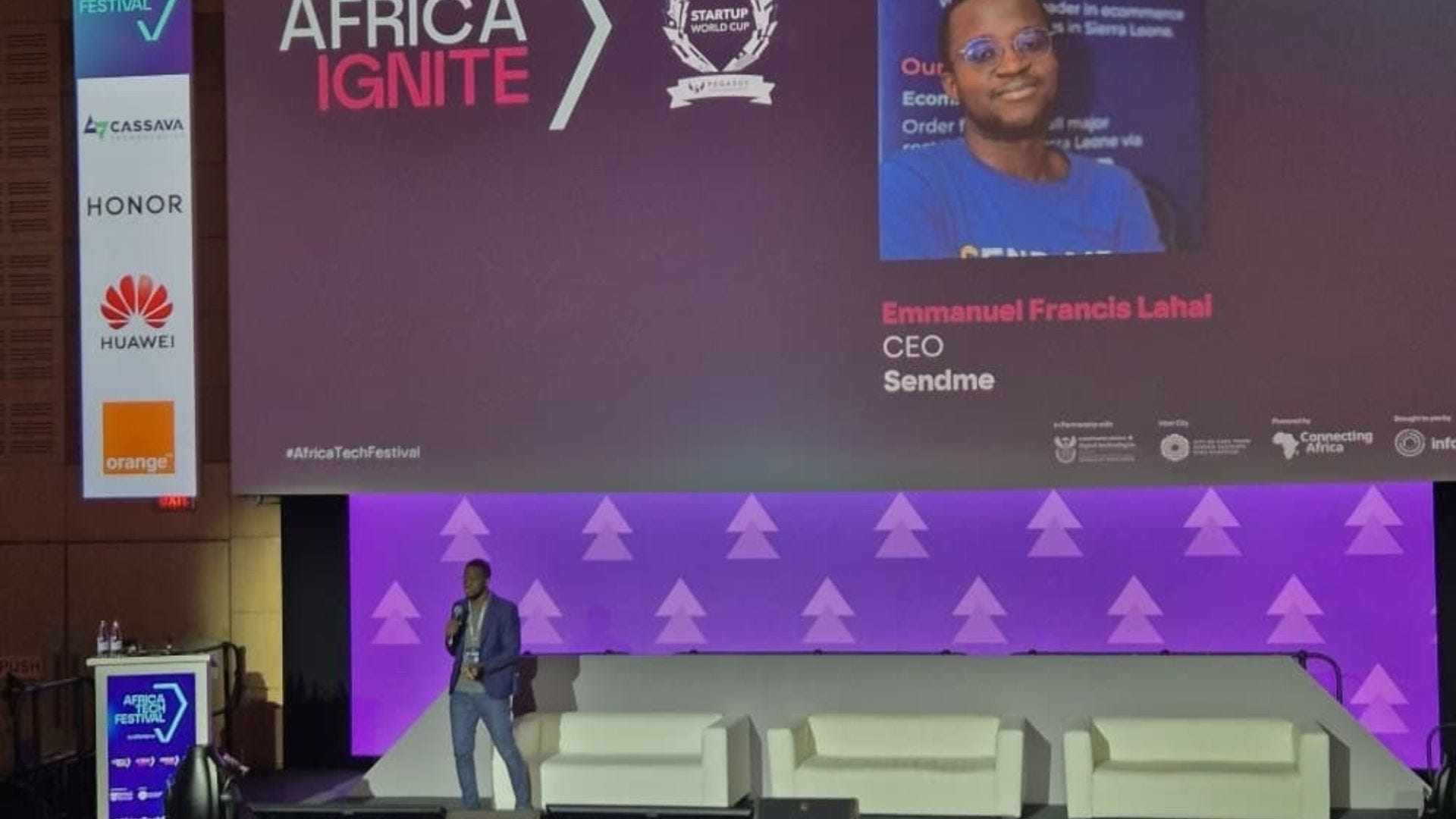
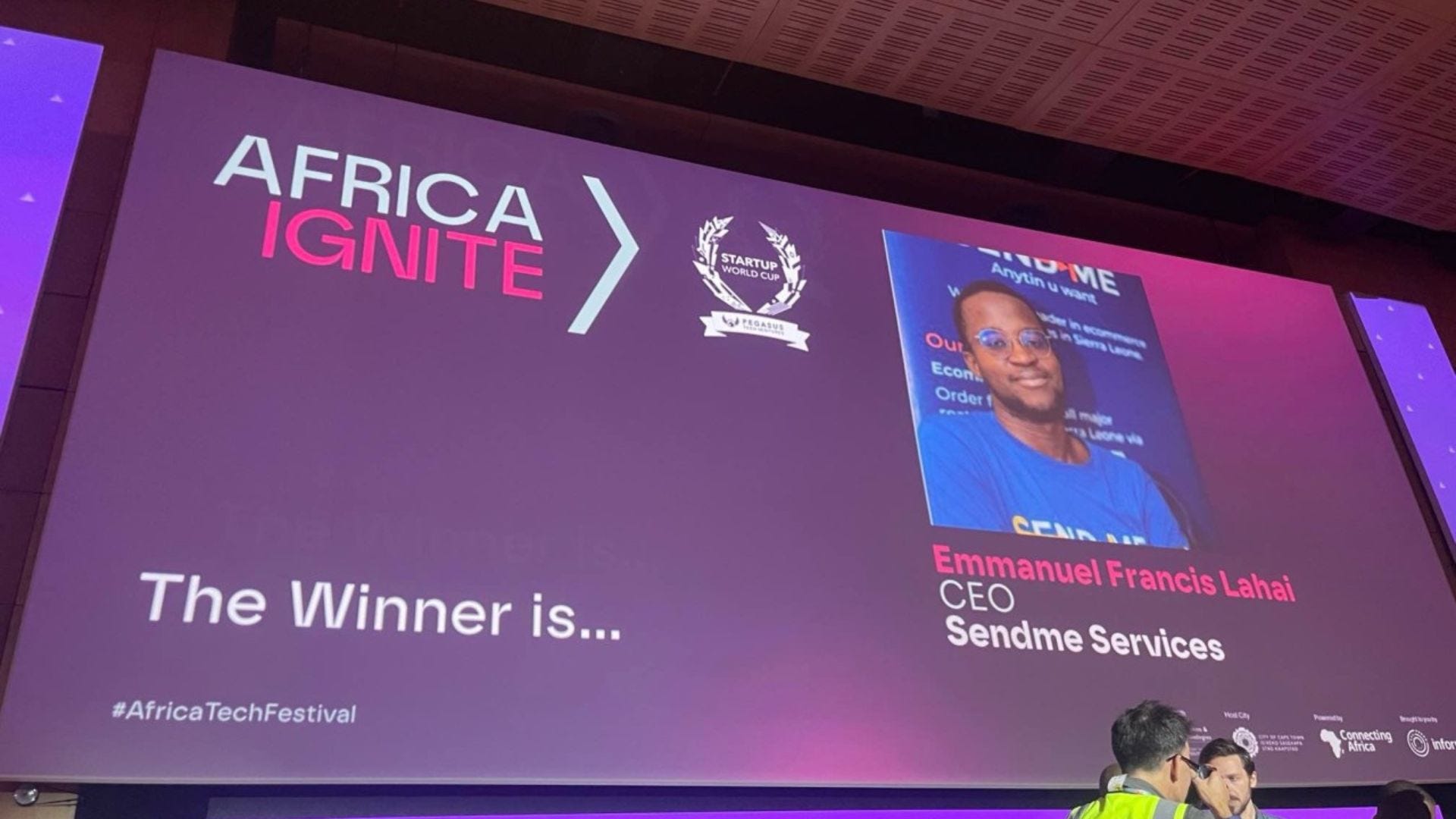
Emmanuel Lahai is the founder of Send Me, a fast-growing e-commerce and delivery platform, recently crowned winner of the Startup World Cup semi-final at the Africa Tech Festival in Cape Town.
The nod was a victory that has opened a path to Silicon Valley, and a chance to compete for a $1 million prize.
From Civil Engineering to Software Startups
Emmanuel’s path into entrepreneurship did not begin with a perfect plan — it began with adaptation.
He originally founded Send Me as a platform to connect service providers with customers.
But his worldview changed when he received a scholarship to study Civil Engineering in China.
While abroad, he witnessed the full potential of e-commerce and realized how far behind Sierra Leone still was in digitising trade.
“I saw the potential of e-commerce and decided why not create something like this in Sierra Leone,” he says.
In a bold move, he left China to build Send Me.
The startup pivoted multiple times until it became what it is today — and along the way, Emmanuel transitioned into software engineering, equipping himself with the tools to build a stronger tech business.

What is Send Me and Why Does It Matter?
Today, Emmanuel describes Send Me as more than a shopping app. It is a system designed to help small businesses operate like modern, digital companies.
“Send Me is an ecommerce and delivery platform that offers end to end support for businesses — from logistics, to storage, to a digital store front — making it possible to launch a business from your home,” he explains.
In a country where many entrepreneurs struggle with distribution, customer access, and reliability, Send Me is positioning itself as a practical bridge between sellers and consumers. But Emmanuel’s ambition goes even further.
“Our long term plan is to digitize businesses in Africa and create a crossborder ecommerce platform where SMEs in Lagos can sell to customers in Freetown vice versa.”
What Makes Send Me Different
In a region where many platforms focus only on one part of the chain — like delivery or online listings — Send Me is built on what Emmanuel calls an end-to-end approach, offering businesses a full package: logistics, storage, and digital storefront support.
He also points to an emerging advantage: AI-powered support for businesses.
“What makes us unique is our end to end approach and also our AI support for businesses which will give them insight on their business and help boost sales,” he says.
More importantly, Emmanuel says Send Me is not thinking country-by-country, but continent-wide.
“Instead of looking at each country as an individual entity we are looking at it as a whole and working on connecting them.”
Numbers and Milestones
Send Me’s progress is not only a story of vision — it is also measurable.
To date, the platform has recorded:
· 35,000+ orders completed
· 8,500+ customers
· 200+ businesses served
· A UNDP grant
· And a major breakthrough: winning the Startup World Cup semi-final
For a Sierra Leonean startup operating within a difficult funding and infrastructure environment, these numbers signal real traction — and growing trust.
The magic pitch
The turning point came during the Africa Tech Festival, where Emmanuel joined the Startup World Cup regional competition with a clear strategy.
“I saw it as an opportunity to showcase my startup to this peculiar audience,” he explains. “Everyone at the festival was key to the industry and I wanted to be seen.”
The pitch itself was a memorable experience — and surprisingly smooth.
“It was surreal,” Emmanuel says. “The event organization was great, the setup was wonderful, it was professional and made me feel comfortable.”
Unlike many startup competitions where entrepreneurs face technical delays and chaotic logistics, Emmanuel says everything at this event worked — allowing him to focus on performance and message.
What helped him win?
“It was my ability to demonstrate the scale of the problem we are solving, its importance, and show an exit strategy for the investors,” he says. “The investors could see what I was doing, how I was going to do it and how they were going to get their return.”
Silicon Valley and the $1 Million Question
Now, Emmanuel is preparing for the final stage: pitching in Silicon Valley, a global capital of technology, investment, and innovation.
He says he is refining his investor messaging, informed by lessons from the Africa Tech Festival — including a session by investor Zachariah George from Launch Africa, which sharpened his understanding of what investors want.
“This gave me better insight into understanding the wants and expectations of investors and I tailored my pitch based on this new found information,” he says.
For Send Me, winning the $1 million would be transformational.
“Winning the $1m will give us the opportunity to scale our vision across the region faster and give us a better edge in the international market,” Emmanuel says. “It will also increase the scope of businesses we’ll be able to support.”
But the impact would go beyond one company.
“For Sierra Leone it will be a massive win for the startup ecosystem,” he adds. “It will bring spotlight to the nation’s tech industry… and attract investors as it will show that if given the same opportunities, startups from smaller economies can also perform.”
The Real Struggles: Funding and Culture
Despite its growth, building an e-commerce business in Sierra Leone is not easy — and Emmanuel is direct about what slows progress the most.
“The biggest challenge has been access to funding to support the overhead of running an ecommerce company,” he says. “It has been difficult to scale and most times scaling is very slow because we don’t have the resources to move fast.”
He also points to a cultural barrier that many e-commerce platforms across Africa still face: consumer habits.
“Most people are still accustomed to going to the store and buying instead of trusting an online platform.”
This is the hard reality behind digital transformation — technology is not only about apps; it is about behavior, trust, and changing routines.

Lessons for the Next Generation of African Founders
Asked what advice he would give to other African entrepreneurs, Emmanuel keeps it practical and survival-focused.
“Stay alive. Don’t give up. Keep learning and pivoting until you achieve your goal,” he says.
And then he adds an unexpected but important point for startups growing into partnerships and contracts:
“Get a lawyer friend or a lawyer and seek their advice in almost everything you do after you start working with other parties.”
The Vision: A Cross-Border African Marketplace
In the next three to five years, Emmanuel wants Send Me to move beyond Sierra Leone and become a serious player in Africa’s e-commerce infrastructure.
“I see Send Me as being established in almost all countries in West Africa and in some countries in East and southern Africa,” he says.
His vision is bold: millions of monthly transactions and logistics strong enough to support cross-border trade across African nations.
“I see Send Me creating an Africa where a client can order a product in a different African country and get it delivered in 5 business days.”
Symbolism
For Emmanuel, success is not only commercial—it is symbolic.
“In Sierra Leone the most successful people are mostly people in politics or from family businesses,” he says. “If a startup like Send Me succeeds it will inspire an entire generation of youths that it is possible.”
In a country where many young people still struggle to imagine a future through technology and innovation, Emmanuel believes Send Me can help rewrite what “success” looks like.
For now though, the start-up needs support. As the business scales toward its next chapter, Emmanuel makes it clear: I’m actively looking for investment.
“We’re raising funds to scale our operations and fine tune our business model,” he says. “So if you’re interested or know someone that will be interested, that will be great.”
As African startups compete globally for visibility, funding, and recognition, Emmanuel Lahai’s story highlights the powerful reality that innovation is not limited to the biggest economies.
With the right ecosystem support, Sierra Leone’s tech sector could become one of West Africa’s most surprising growth stories in the years ahead.