


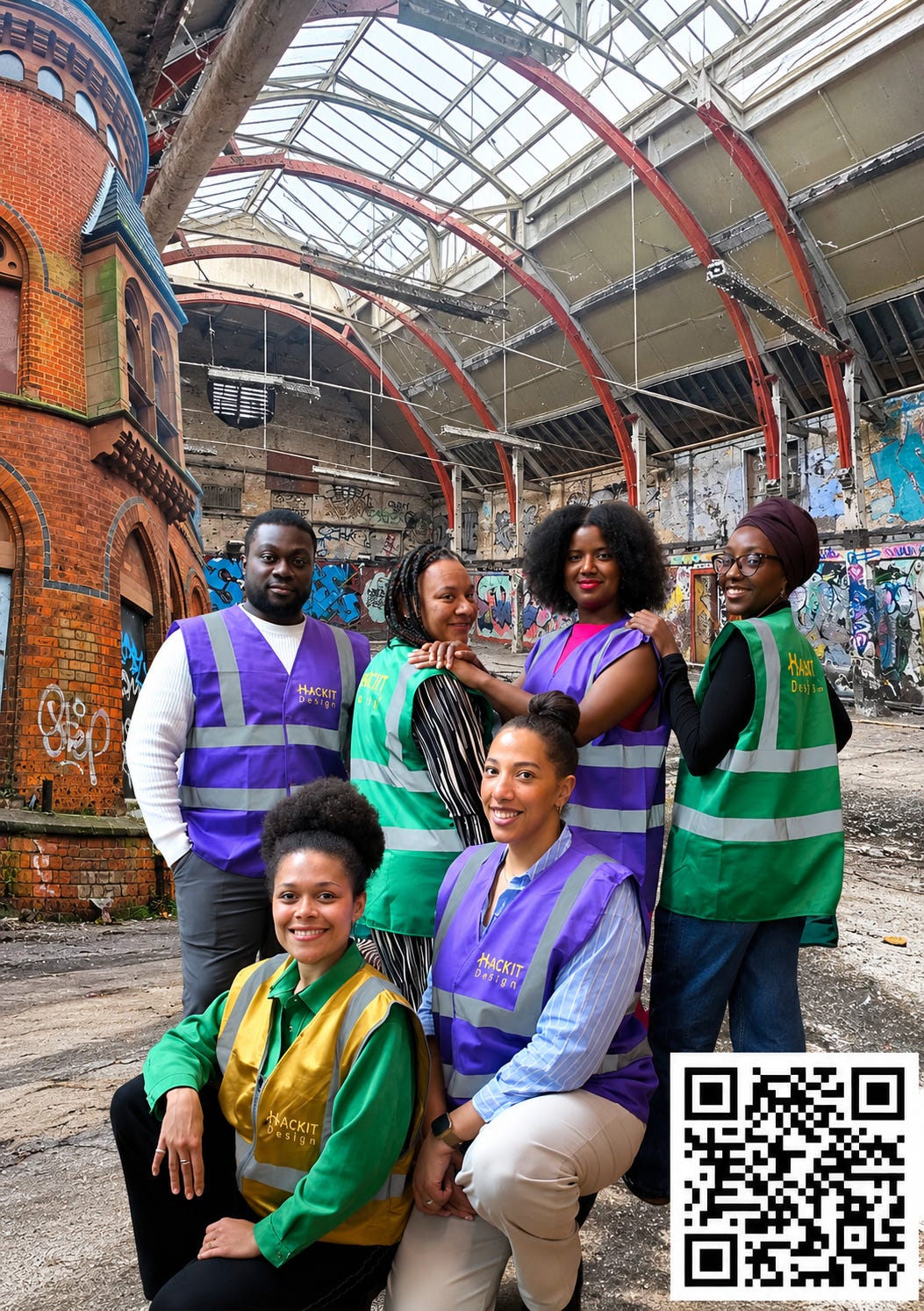

A Black-led social enterprise in southeast London is seeking public support for an ambitious plan to bring one of Lewisham’s historic landmarks back into community use, with a particular focus on disabled, neurodivergent, and underserved residents.
Hackit Design CIC is campaigning to take on the restoration of Ladywell Playtower, the Grade II-listed former public baths on Ladywell Road. The organisation is trying to raise an initial £10,000 to pay for surveys, feasibility work, and other professional studies needed to strengthen its bid to become the building’s restoration partner.
For Angela Stewart, founder of Hackit Design CIC, the campaign is about more than preserving an old building.
“Ladywell Playtower is a Grade II listed civic landmark, and it has been left vacant for too long,” she told The African Gazette. “The longer it sits unused, the more it deteriorates and the more expensive it becomes to save.”
The building has a long place in Lewisham’s history. Originally opened as public baths in 1884, it is considered one of London’s earliest surviving public bath buildings. It later became a community facility known as Ladywell Playtower, hosting activities including gymnastics before closing in 2004. It was Grade II listed in 2006.
Its future has been uncertain for years. An earlier redevelopment plan, which envisaged restoring the building as a cinema with a restaurant and bar, stalled after the developer encountered financial viability problems. Lewisham Council subsequently ended that development agreement and launched a new search for a long-term restoration partner. The process, which began in December 2025, is due to run into late 2026.
A £10,000 first step
Hackit Design does not own the Playtower, and Angela Stewart stresses that the organisation has not yet secured a lease.
The building remains owned by Lewisham Council, which is responsible for selecting a restoration partner and determining the legal arrangement under which the successful organisation would take responsibility for the site.
The £10,000 Hackit Design is seeking through crowdfunding would therefore not pay for the restoration itself. Instead, Stewart describes it as money for the urgent “bid-winning” stage.
The funds would support measured surveys, conservation and heritage advice, accessibility and inclusive-design planning, as well as specialist assessments of potential risks such as asbestos and contamination. Part of the money would also be used to involve residents in shaping the proposal.
“We need to raise £10,000 now so we can complete early-stage surveys, feasibility and professional work that demonstrate credibility and readiness and unlock larger funding,” Stewart said.
The eventual cost of restoring the Playtower has not yet been determined. Stewart said Hackit Design deliberately does not want to announce a headline figure before professional surveys and cost planning have established what the building actually requires.
If its bid succeeds, the organisation plans to approach the restoration in phases, beginning with structural assessments, urgent stabilisation and repairs, and detailed planning for accessibility, fire safety and building services.

Designed around people often excluded

Hackit Design CIC describes itself as a Black-led, not-for-profit social enterprise whose work is informed by experience of disability and neurodivergence.
That background is central to its proposal for Ladywell Playtower.
“Our vision is shaped by lived experience,” Stewart said. “We understand how exclusion shows up in everyday environments and how that affects health, confidence, and participation.”
She said the organization wants the restored building to address issues including privacy, dignity, cultural sensitivity, and sensory comfort, rather than treating accessibility simply as a matter of ramps and physical access.
The organisation proposes a mixed financial model intended to keep the facility sustainable while maintaining affordable access. Standard-priced sessions and venue hire would help cover running costs, while free or reduced-cost access would be targeted at people on low incomes and groups facing additional barriers.
Disabled and neurodivergent residents, carers, young people, and people living with long-term health conditions are among those Hackit Design expects to benefit.
Stewart said the organisation ultimately hopes the Playtower could serve thousands of people annually, although precise numbers will not be published until an operational plan has been completed.
Heritage and accessibility
Transforming a Grade II-listed Victorian building into an accessible modern community facility presents another challenge.
The former Ladywell Baths is a Grade II-listed building of architectural and historical significance. Dating from 1884, it retains elements of its original Victorian public-bath design.
Stewart argues that preserving that history and making the building accessible should not be seen as competing objectives.
“Accessibility and heritage are not in conflict: a civic building survives when it is used and loved,” she said.
Hackit Design proposes what Stewart calls a “conservation-led, restoration-first approach,” retaining important historic features while making alterations as limited and reversible as possible.
Pressure on community space
The campaign also comes amid wider changes in Lewisham.
Stewart is concerned that major redevelopment elsewhere in the borough could displace community organisations from existing premises. She believes Ladywell Playtower could provide a permanent base for some activities that might otherwise struggle to find affordable and accessible space.
“Major redevelopment can displace community activity, even when it is valued and well-used,” she said.
Her vision is for the Playtower to provide space for wellbeing programmes, practical support, training, community meetings, and social activities.
Residents have responded positively to the proposal, Stewart said, particularly to the emphasis on affordable community facilities and accessible well-being services. Hackit Design is gathering letters and statements of support and taking part in the Council’s process.
The council itself has said community views are intended to play a central role in selecting a new restoration proposal. Its partner search calls for a scheme that can protect the Playtower’s historic character while being financially viable and responsive to local priorities.
A building brought back to life
For Angela Stewart, however, the campaign also has a personal dimension.
Five years from now, she hopes to see the Playtower fully restored and busy again—a building where residents can seek support, learn skills, meet others, and find work opportunities.
She particularly wants people who often experience exclusion in public spaces to feel that the building belongs to them too.
“It would mean seeing a building that has been left behind become a place of safety and belonging again,” Stewart said. “It would mean people who are often excluded walking into a space and feeling calm, respected, and able to take part.”
For now, the much bigger restoration remains dependent on the outcome of Lewisham Council’s selection process and on the ability of any successful partner to secure substantial further funding.
Hackit Design’s immediate target is much smaller: £10,000.
But Stewart sees that first fundraising drive as the foundation for something considerably larger—demonstrating community backing, completing the professional work needed to make the proposal credible, and, ultimately, giving a Victorian landmark another chance to serve the people of Lewisham.