



The architecture of modern international law was built in the shadow of the Second World War, with a clear ambition: to constrain war, regulate violence, and preserve global order. Nearly eight decades later, that framework is under unprecedented strain.
A growing consensus among legal scholars holds that the concept of war itself has largely disappeared from international law, replaced by more technical constructs such as the prohibition of the use of force under Article 2(4) of the United Nations Charter and the classification of armed conflicts under international humanitarian law (IHL). Yet this view may be both incomplete and dangerously complacent.
In reality, war has not disappeared—it has evolved. And international law is struggling to keep pace.
The Legal Framework: Designed for a Different Era
The cornerstone of modern international law remains the UN Charter. Article 2(4) prohibits the use of force, while Article 51 preserves the inherent right of self-defense “if an armed attack occurs.”
This framework was crafted with inter-state wars in mind. But contemporary conflicts increasingly unfold in a legal grey zone—where attribution is uncertain, actors are fragmented, and violence is calibrated to remain below traditional thresholds.
The International Court of Justice (ICJ) attempted to clarify these thresholds in the landmark Nicaragua v United States judgment, distinguishing between the “most grave forms of the use of force” (armed attacks) and less severe violations. However, this distinction now appears increasingly ill-suited to modern realities.
Cyber operations, proxy warfare, and disinformation campaigns can inflict strategic harm without ever crossing the classical “armed attack” threshold.

Hybrid Warfare and the Crisis of Attribution
One of the most significant challenges facing international law today is attribution. In cyber warfare and proxy conflicts, states can operate through intermediaries, maintaining plausible deniability.
The ICJ addressed aspects of this problem in Bosnia and Herzegovina v Serbia and Montenegro, where it adopted a stringent “effective control” test for state responsibility. By contrast, the International Criminal Tribunal for the former Yugoslavia (ICTY) in the Tadić case proposed a more flexible “overall control” standard.
This divergence illustrates a deeper problem: international law lacks a coherent and adaptable framework for linking states to the actions of non-state actors. As a result, accountability is often elusive.
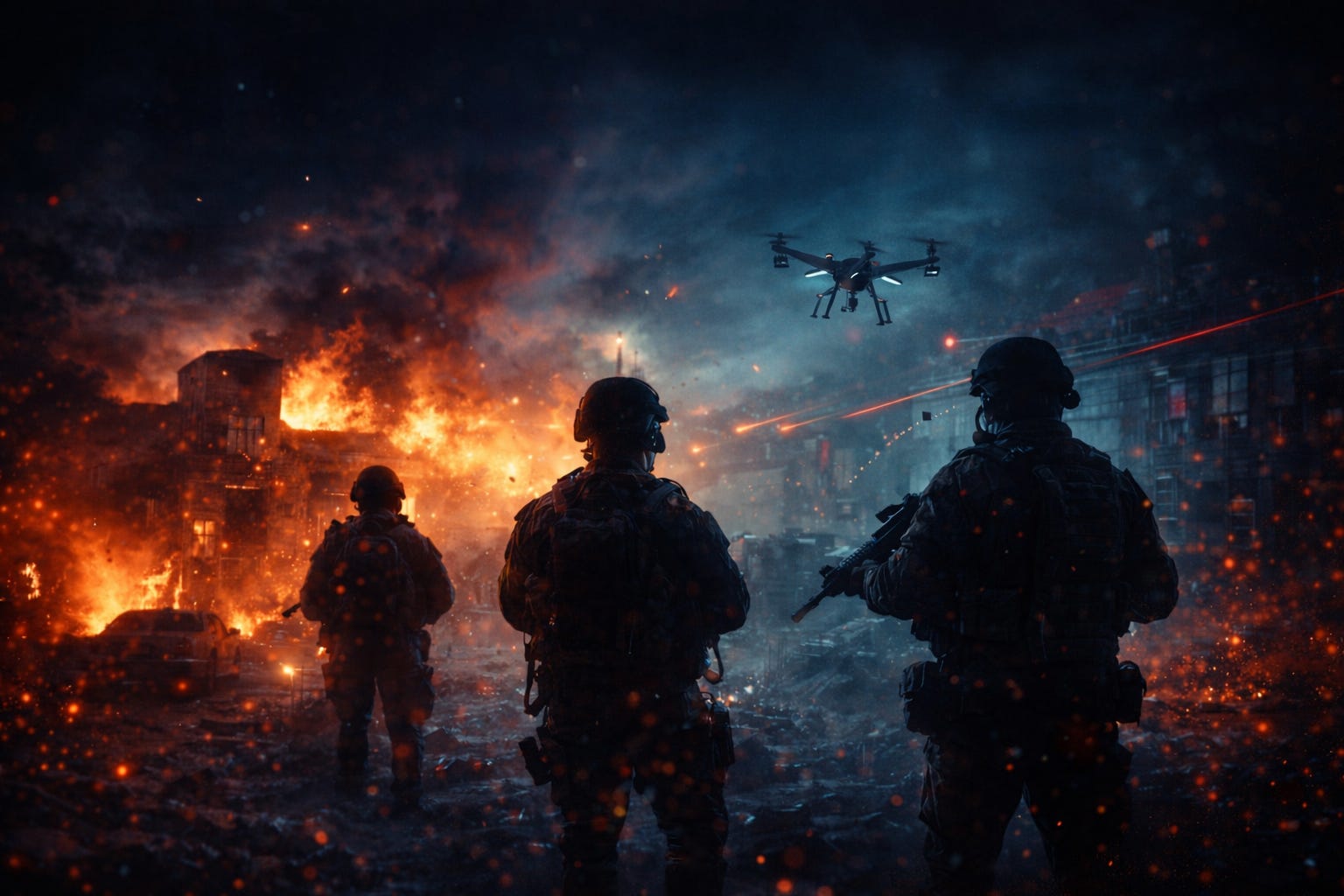
The Rise of “Below-Threshold” Conflict
Modern warfare increasingly operates through incremental, low-intensity actions—cyber intrusions, economic coercion, targeted strikes, and proxy engagements—that fall below the legal threshold required to trigger self-defense.
Scholars have responded by proposing doctrines such as the “accumulation of events” theory, whereby a series of minor attacks, taken together, may constitute an armed attack. While not formally codified, this approach has gained traction in state practice and academic debate.
Similarly, the idea of incremental escalation suggests that states should not be required to absorb sustained hybrid aggression before responding. Yet these evolving interpretations risk eroding the clarity—and restraint—that international law was designed to impose.
Occupation Without Presence
Technological advances are also reshaping the concept of territorial control. Traditional definitions of occupation, rooted in the Hague Regulations and the Geneva Conventions, assume physical presence—“boots on the ground.”
But what happens when control is exercised remotely?
Drones, surveillance systems, and AI-enabled targeting now allow states to exert influence without permanent deployment. This phenomenon—sometimes described as “remote” or “ghost” occupation—challenges the very foundations of occupation law.
Non-State Actors at the Center of Conflict
International humanitarian law was built around conflicts between states. Today, however, many of the most consequential actors are non-state groups—militias, insurgents, and transnational networks.
While Common Article 3 of the Geneva Conventions and Additional Protocol II attempt to regulate non-international armed conflicts, gaps remain significant. These actors often operate outside formal legal structures, complicating both compliance and enforcement.
Security Dilemmas and the Expansion of Self-Defense
Across regions, states increasingly invoke self-defense against threats that blur the line between war and peace. In the Middle East, Israel cites attacks by armed groups such as Hezbollah and Hamas to justify a broader reading of Article 51 of the UN Charter. In Europe, Ukraine has relied on collective self-defense following Russia’s invasion, reinforcing the centrality of Article 51. In Africa’s Sahel, states confront cross-border insurgencies, raising unresolved legal questions about the use of force against non-state actors in neighbouring territories. Similarly, Rwanda has pointed to armed groups operating across its borders as a source of ongoing insecurity. Yet the International Court of Justice, in Nicaragua v United States (1986), set a high threshold for what constitutes an “armed attack,” leaving many of these situations in legal ambiguity. Expanding self-defense without clear limits risks eroding the prohibition of force under Article 2(4).
Adaptation or Irrelevance
Not all scholars believe new treaties are required. Some argue that existing law can be adapted through interpretation and practice.
Soft law instruments—such as the Tallinn Manual—demonstrate how traditional principles of sovereignty, necessity, and proportionality can be applied to emerging domains like cyberspace.
Yet soft law lacks binding force. Without broader consensus, fragmentation may deepen.
Conclusion: A System at a Crossroads
International law stands at a critical juncture. Its foundational principles—distinction, proportionality, and necessity—remain indispensable. But the environment in which they operate has changed dramatically.
If the law does not adapt to the realities of hybrid warfare, technological transformation, and non-state actors, it risks becoming not only outdated but irrelevant. Worse still, it may provide a veneer of legality for actions that undermine the very order it seeks to uphold.
The challenge, therefore, is not to abandon international law, but to ensure that it evolves—carefully, coherently, and collectively—to meet the demands of modern warfare.
